Spine rehabilitation at a sanatorium: treatments, safety, and choosing a stay
Author: Anna Bielińska · Published: · Updated:
Does getting up in the morning take longer and longer, does bending down to pick up your shopping require caution, and does a walk end earlier than it used to? Spinal pain can make it hard to sleep, drive, care for loved ones, and even get up from a chair. When symptoms keep coming back or persist for weeks, a well-organised rehabilitation stay can help you return to regular movement and learn to manage your symptoms safely.
A sanatorium, however, is not a "reset for the spine" or a universal cure for every cause of pain. Much depends on a proper assessment, a programme built primarily around active exercise, and following the recommendations after you return home. In this guide, we explain which elements of a stay matter most, how to assess an offer, and when urgent medical help is needed instead of planning a trip.
If you're wondering whether now is a good time for a change of scenery and recovery, also read the guide 5 signs your body needs recovery.
In brief: what to look for with different complaints
The choice of stay should be guided by your current symptoms, functional ability, coexisting conditions, and ability to safely take part in exercise. The name of a diagnosis, an MRI report, and the location of a health resort are not enough on their own.
| Situation | Most important programme element | What to check before booking |
|---|---|---|
| Chronic, non-specific low back pain | Individually tailored exercise, education, and a gradual return to daily activity. | Whether the programme includes regular kinesiotherapy, a functional assessment, and a home exercise plan. |
| Degenerative changes and stiffness | Exercises for mobility, strength, balance, and endurance; water-based sessions can be a supplement after assessment. | Whether the physiotherapist can adjust the load, and whether the facility is accessible without excessive stair climbing. |
| Sciatica or pain radiating to the leg | A neurological assessment and carefully graded movement matched to how symptoms respond. | Whether symptoms are stable. New weakness, numbness in both legs, or bladder and bowel problems require urgent help. |
| Neck and shoulder girdle pain | Assessment of mobility, strength, balance, upper-limb function, and everyday ergonomics. | Whether the programme takes into account hand numbness, dizziness, balance problems, and other neurological symptoms. |
| After surgery, a fracture, or an injury | A programme consistent with the stage of healing and the treating doctor's recommendations. | The doctor's approval, the facility's experience in post-operative rehabilitation, and the procedure for worsening symptoms. |
1. Is a sanatorium a good choice for spinal rehabilitation?
A sanatorium can be a good place for rehabilitation when your health is stable and the goal is to improve functional ability, reduce limitations in daily life, and return to regular activity. This most often applies to chronic or recurring complaints, and to a further stage of recovery after acute treatment has ended.
Don't choose a stay based solely on the term "disc disease", an MRI report, or information that a facility has a wide range of equipment. The rehabilitation plan should be guided by symptoms, a functional examination, exercise tolerance, and what genuinely makes daily life difficult: walking, bending, sleeping, sitting for longer periods, driving, or caring for loved ones.
When a stay may make sense
- pain or stiffness persists or keeps coming back, but there are no warning signs;
- you need regularity and supervision that's hard to maintain in your everyday routine;
- a doctor or physiotherapist has recommended further rehabilitation after an injury, surgery, or outpatient treatment;
- you can safely travel, get to sessions, and use the facility's infrastructure on your own or with previously arranged help;
- you want to learn exercises and principles that you can continue to follow after returning home.
When a consultation is needed first
- the pain appeared suddenly, is very severe, or is quickly worsening;
- there's new limb weakness, a sensory disturbance, or a problem with balance or walking;
- symptoms appeared after a recent injury or surgery, without a doctor's approval for the stay;
- you don't know the cause of your symptoms, or their character has clearly changed;
- you have unstable heart or lung disease, or another condition where exertion, heat, cold, or other treatments involving physical stimuli could be dangerous.
The Polish National Health Fund (NFZ) points out that health resort treatment is a continuation of earlier treatment, and the assessment must take into account the ability to travel, care for yourself, and undergo treatments. It involves therapeutic exposure to physical and natural stimuli, so indications and contraindications matter for a privately funded stay too.
2. What can a well-planned stay offer?
The greatest value of a stay isn't a single "best treatment", but the combination of several elements into a coherent plan. WHO stresses that in chronic primary low back pain, care should be tailored to the person and often requires a set of interventions, rather than a single method used in isolation.
| Element of the stay | Why it matters |
|---|---|
| Regularity | Fixed session times help you move from occasional "I exercise when it hurts" to a safe routine. |
| Supervision | A physiotherapist can correct technique, adjust difficulty, and respond to changes in symptoms. |
| Conditions for movement and rest | It's easier to combine exercise, walks, meals, sleep, and recovery when you don't have to arrange each journey separately. |
| Education and a plan for after you return | Understanding your symptoms, the rules for grading effort, and your own programme increases the chance of staying active after the stay. |
| A change of scenery and contact with others | For some people, group activities, shared walks, and a break from household duties support motivation. This is a possible benefit of the stay, not a guaranteed treatment effect. |
How to measure progress
A reduction in pain matters, but it shouldn't be the only measure of success. Before your trip, write down three specific activities that are currently difficult, then reassess them at the end of the stay:
- how long you can walk or stand without a break;
- whether you get up from a bed or chair more easily;
- whether you sleep more peacefully and wake less often due to pain;
- whether you perform everyday movements with more confidence, instead of constantly avoiding them;
- whether you know a safe set of exercises and can adjust their difficulty.
3. What should the initial assessment and stay plan look like?
A good programme starts with the question "What do you want to regain?", not with a list of equipment. For one person, that might be walking a kilometre without a break; for another, putting on socks independently, safely lifting a light bag, or getting back to gardening.
| Stage | What should happen |
|---|---|
| Before arrival | The facility provides requirements regarding documentation, a health questionnaire, medicines, and contraindications to selected treatments. |
| Start of the stay | A doctor or physiotherapist takes a history, assesses health and function, sets goals, and selects the active and complementary elements of the programme. |
| During the stay | Staff observe your response to exertion and can reduce, increase, or change the load. Increased pain shouldn't automatically be taken as proof of effectiveness. |
| Before departure | You receive an understandable home exercise plan, rules for grading activity, and information on when a follow-up consultation is needed. |
The consultation shouldn't be limited to simply noting the name of a condition. Staff should ask about the nature and duration of the pain, whether it radiates, previous treatment, surgery, medicines, coexisting conditions, warning signs, and how the complaints affect daily activities. It's worth assessing, among other things, your gait, mobility, strength, balance, and exercise tolerance.
Before you book, also ask what happens to the price and schedule if, after the medical assessment, some of the paid-for treatments cannot be provided. The rules for substitution, cancellation, or settlement should be clear before booking.
What a typical day might look like
| Time | Example element | Goal |
|---|---|---|
| Morning | A brief wellbeing check, a gentle warm-up, or individual exercises. | Matching the load to the body's current response. |
| Late morning | Kinesiotherapy, water-based exercise, or gait training. | Active work towards a functional goal. |
| After exercise | A chosen complementary treatment and rest. | Improving comfort and recovery, without replacing movement. |
| Afternoon | A walk, group activities, learning about ergonomics or home exercises. | Transferring the effects to everyday activities. |
| Evening | A short note on symptoms: pain, fatigue, walking distance, sleep. | Making it easier to talk with the therapist and adjust the programme. |
There's no single correct number of daily treatments for every guest. More isn't always better: excessive fatigue can get in the way of doing the most important exercises and of resting between treatments.
4. Which treatments matter most?
Polish health resorts offer, among other things, kinesiotherapy, hydrotherapy, massage, peat mud treatments, heat therapy, and various physical modalities.[5] The fact that a method appears in a facility's catalogue doesn't mean it will be needed by everyone with spinal pain. The final set of treatments should be based on the assessment and lead towards a specific goal.
4.1. Kinesiotherapy and education — the foundation of the programme
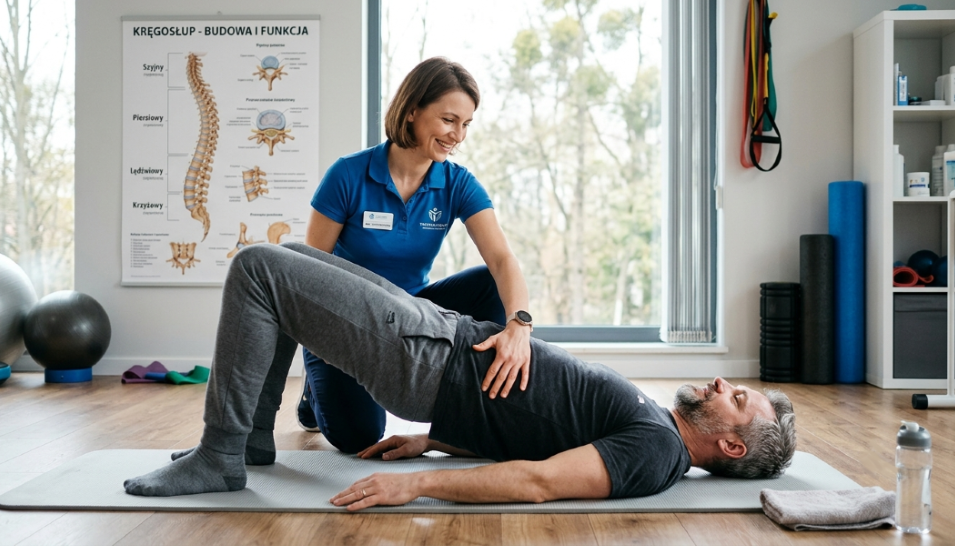
Kinesiotherapy, or treatment through movement, should be the core of the stay, especially for chronic non-specific low back pain. Exercises can include improving mobility, strength, endurance, balance, general fitness, and learning to perform everyday activities safely. There's no single set that's good for everyone: the programme should take into account your abilities, preferences, and response to exertion.
WHO recommends exercise programmes and education supporting self-management of chronic primary low back pain. A Cochrane review indicates that exercise probably reduces pain, while the average effect on functional limitations is smaller and depends on many factors.
A good physiotherapist shouldn't just hand over a sheet with exercises. They should demonstrate the movement, check how it's performed, explain what responses to exercise are acceptable, and prepare a simple plan for the first weeks after you return.
4.2. Water-based exercise and hydrotherapy
Water's buoyancy reduces the perceived load, which is why some people find it easier to start moving in a pool than in an exercise room. Water-based exercise can be a useful supplement to the programme, especially when walking or moving on land is initially difficult.
A review of studies suggests a possible improvement in pain and function in people with chronic low back pain, but the certainty of the evidence was assessed as low or very low.[7] Water is therefore not "better for everyone" and doesn't replace individual assessment.
Before booking, check the water temperature, how you enter the pool, whether there are handrails or a lift, and who runs the sessions. Infections, recent wounds, some skin conditions, and certain circulatory diseases can limit the ability to use the pool or warm baths.
4.3. Massage and manual therapy
Massage and selected manual techniques can temporarily reduce tension, improve comfort, and make it easier to do exercises. They shouldn't, however, make up the whole programme. NICE recommends considering manual therapy only as part of a package that includes exercise, and in some cases also a psychological approach to chronic pain.
4.4. Peat mud, baths, and heat therapy
Heat and balneological treatments are a characteristic part of health resort treatment. For some guests, they can improve comfort and make later exercise easier. Treat them as a possible supplement, not a substitute for active rehabilitation. They don't "rebuild" intervertebral discs or reverse degenerative changes.
Heat and other stimulus-based treatments have physiological effects on the body. Before a treatment, factors such as the condition of the circulatory system, the skin, recent inflammation, and other contraindications identified by medical staff must be taken into account.
4.5. Physical modalities: more equipment doesn't mean a better programme
Laser therapy, magnetic field therapy, electrical currents, or ultrasound are sometimes presented as the main selling point. The quality of rehabilitation is better judged by the examination, the active programme, the ability to modify the plan, and the recommendations provided for home.
Regarding low back pain and sciatica, NICE does not recommend routinely offering traction, ultrasound, TENS, or interferential therapy. This doesn't mean every physical modality is inappropriate for every diagnosis. It does mean that a treatment should have a clearly defined purpose, justification, and a way of assessing its effect — and shouldn't replace exercise.
5. How to match a stay to the type of complaint?
The name of a diagnosis matters, but it's not enough on its own to choose a programme. Two people with the same MRI report can have different symptoms, functional ability, and goals. What counts is the current clinical picture, the stage of the condition, coexisting illnesses, and the response to movement.
Chronic low back pain with no single identifiable cause
The programme should combine exercise, a gradual return to activity, education, and — depending on need — work on sleep, stress, and fear of movement. It's not worth focusing the whole stay on finding one "damaged spot" if the doctor hasn't identified a specific cause requiring a different approach.
Degenerative changes and stiffness
A description of degenerative changes doesn't rule out activity. The goal is to improve function around the affected structures: strength, mobility, endurance, balance, and confidence in movement. The programme should also take into account the hips, knees, fall risk, and chronic conditions affecting exercise tolerance.
Disc disease and sciatica
Pain radiating to the leg calls for particular caution. It's necessary to distinguish stable symptoms that may be suitable for rehabilitation after assessment, from worsening weakness, sensory disturbances, or symptoms of cauda equina syndrome. Exercises should be modified based on how symptoms respond, not performed mechanically according to a universal set.
Neck and thoracic spine pain
It's worth assessing shoulder and chest mobility, upper limb strength, sitting and reading posture, and symptoms such as hand numbness, balance disturbances, or dizziness. Forceful manipulations shouldn't be performed without proper assessment, an explanation of the risks, and informed consent.
After surgery, a fracture, or an injury
The timing and scope of rehabilitation are decided by the treating doctor. Bring your discharge summary, recommendations, information about movement restrictions, and follow-up appointment dates. The facility should confirm that it provides rehabilitation at that stage of recovery and has a clear procedure for what happens if concerning symptoms appear.
6. A 7-, 14-, or 21-day stay?
The length of a stay affects the number of repetitions, the ability to adjust the programme, and how well habits become established. There is, however, no honest guarantee that a given number of days will eliminate the pain. The effect depends on the cause and duration of the complaint, your physical condition, exercise regularity, sleep, stress, and continuing the programme after you leave.
| Length | What can realistically be achieved | Limitations and questions |
|---|---|---|
| 7 days | Carry out an assessment, learn how you respond to exercise, learn a basic exercise set, and start a regular rhythm. | Little time for repetition and adjustment. Check how many days actually involve rehabilitation, especially around a weekend. |
| 14 days | Repeat exercises, grade the load, correct technique, and assess your response over subsequent days. | Higher cost and a longer time away from home. A plan for continuing at home is still needed. |
| 21 days | Take a more gradual approach to building endurance, confidence in movement, and habits, especially with greater limitations. | A longer stay doesn't guarantee a greater effect. What matters is the quality of the programme, exercise tolerance, and rest. |
7. How to choose a good sanatorium for spinal rehabilitation?
The best facility isn't the one with the longest list of treatments, but one able to match the programme to your situation and provide conditions for safe participation. Before booking, ask for specifics.
- Does the facility regularly work with people who have similar complaints and a similar level of functional ability?
- Who assesses guests for treatments, and who can change the programme during the stay?
- How many active sessions does the price include, how many of them are individual, how long do they last, and how large are the groups?
- Does the programme take into account heart disease, hypertension, diabetes, osteoporosis, joint replacements, and fall risk?
- Will you receive an exercise plan, walking guidelines, and criteria for increasing the load at the end of the stay?
- What happens to the price and schedule if some treatments turn out to be contraindicated after assessment?
- Are the treatment rooms, dining room, and your room accessible by lift, and are there handrails and resting places along the way?
- How do you enter the pool, and are there handrails, gently sloping steps, or a lift available?
- Who can you contact, and how quickly, if your symptoms get worse?
- Will the room standard, diet, session times, and distance from the treatment area allow you to genuinely take part in the programme?
Sea, mountains, or lowlands?
Don't automatically link a specific condition to the sea, mountains, or lowlands. For spinal rehabilitation, what matters more is the programme, the staff, the accessibility of the facility, and the ability to walk safely. Mountainous terrain can be an asset for a fit person, but an obstacle for someone with limited balance or endurance. A seaside location can be conducive to walks and rest, but on its own it doesn't treat disc disease or sciatica.
If you have heart or lung disease, blood pressure problems, or tolerate heat, cold, or altitude changes poorly, discuss your choice of climate with a doctor. Also check the distance from your room to the treatment area, the slope of the terrain, benches, and opportunities to rest.
How to read other guests' reviews
Reviews are most helpful when they describe specifics: punctuality of sessions, the physiotherapists' approach, the ability to change the programme, lift access, entry to the pool, or the actual number of active sessions. A single glowing or very critical review doesn't determine the quality of medical care on its own. Look for recurring information and compare it with the scope of the offer.
8. A privately funded stay or NFZ-funded treatment?
Both models can make sense, but they answer different needs. On a privately funded stay, you choose the dates, facility, length, and room standard yourself, and you bear the costs directly. An NFZ referral is not required to book the stay, but the facility may require a questionnaire, documentation, or a medical assessment before specific treatments.
In the public system, an e-referral is issued by a doctor providing care under public health insurance, and an NFZ doctor assesses whether treatment is appropriate, as well as its type and location.[6] According to the NFZ, an adult's stay at a health resort sanatorium lasts 21 days, while health resort rehabilitation at a sanatorium or health resort hospital lasts 28 days. Adults staying at a health resort sanatorium make a partial contribution towards accommodation and meals.
| Criterion | Privately funded stay | NFZ-funded treatment |
|---|---|---|
| Referral | Doesn't require an NFZ referral; the facility's own assessment may be needed. | Requires an e-referral and confirmation by the NFZ. |
| Dates and facility | You choose from the available offers. | Dates, type, and place are determined by the NFZ procedure. |
| Length | Depends on the offer, often 7, 14, or 21 days. | Generally 21 days of sanatorium treatment or 28 days of health resort rehabilitation. |
| Cost | You pay the full cost of the package and any additional services. | Treatments are covered under NFZ funding; adults pay, among other things, part of the cost of accommodation and meals, plus travel costs and local fees. |
| Flexibility | Greater influence over the room, dates, an accompanying person, and the scope of the package. | Less influence over dates and facility; the rules follow from the public system. |
You'll find a full comparison of costs, waiting times, and freedom of choice in the guide Privately funded sanatorium stay or NFZ-funded treatment?.
9. How to prepare for the trip and use treatments safely?
Good preparation makes the assessment easier and lets you focus on rehabilitation rather than dealing with missing documents. Always confirm specific requirements with the chosen facility.
| Documents and health | Things for sessions |
|---|---|
| An identity document and booking confirmation. | Comfortable clothing that doesn't restrict movement. |
| A list of medicines taken, with doses and times. | Stable, broken-in sports shoes. |
| Recent discharge summaries, test results, or recommendations required by the facility. | A swimsuit, sandals, and a cap, only if needed. |
| Information about surgeries, allergies, implants, and medical equipment used. | A small water bottle and a light bag for sessions. |
| Contact details for your treating doctor or a loved one. | Regularly taken medicines in their original packaging. |
Before your trip, write down three functional goals, for example: walk for 20 minutes without resting, sleep more peacefully through the night, or safely lift a light bag from the floor. This will make it easier to assess whether the programme meets your needs.
Don't get a new MRI scan just because you're going to a sanatorium. NICE does not recommend routine imaging for low back pain in non-specialist care; a scan is considered when its result could change management.
You'll find a detailed list of documents, medicines, clothes, and accessories in the article What to pack for a sanatorium? Complete list for 7, 14 and 21 days.
On site: respond to your body's signals
On the first day, mention all illnesses, medicines, implants, surgeries, and reactions to previous treatments. Don't assume that information given at reception has automatically reached every therapist.
- ask about the purpose of each treatment and speak up if you don't understand the instructions;
- don't increase the number of exercises, the load, or the temperature of treatments on your own;
- report chest pain, breathlessness, fainting, severe dizziness, new numbness, weakness, or balance problems;
- after exercise, monitor not only your pain but also your sleep, fatigue, and ability to do everyday things the next day;
- don't compare your number of treatments with other guests — the programmes of two people with similar diagnoses may intentionally differ;
- keep time for rest, hydration, and meals.
10. What to do after you return?
The biggest risk after a stay is falling back into your old rhythm: a few days of rest, and then stopping exercise altogether. Before you even leave, ask for a simple plan that will fit into everyday life.
| Element of the plan | Practical example |
|---|---|
| Exercise | 3–5 exercises you know well, a set number of repetitions, and an easier version for a more difficult day. |
| Activity | Gradually lengthening your walk or another activity you enjoy, instead of trying to "catch up" on a whole week at once. |
| Tracking progress | Once a week, note the distance, how long you can sit without a break, sleep quality, or another function that matters to you. |
| Responding to a bad day | Reduce the load, but don't automatically give up movement altogether. Use the easier version you agreed on earlier. |
| Consultation | Book an appointment with a physiotherapist or doctor if symptoms clearly worsen, change character, or if weakness or a sensory disturbance appears. |
A home plan should be simple enough to carry out even in a normal week. It's better to do a few well-chosen exercises regularly than to try to recreate the whole sanatorium schedule once every few days.
11. Frequently asked questions
Can a sanatorium cure disc disease?
You shouldn't be promised a "cure for disc disease" during a stay. Imaging findings alone don't determine the programme. The goal of rehabilitation is primarily to improve function, movement tolerance, and the ability to manage symptoms independently.
Do I need an MRI before I go?
Not everyone with back pain needs imaging. NICE does not recommend routine imaging in non-specialist care for low back pain, unless the result could change management. The doctor decides whether a scan is needed.
Can I go to a sanatorium with sciatica?
Stable symptoms radiating to the leg may be suitable for rehabilitation after assessment. First, however, an assessment is needed, especially when symptoms are new, quickly worsening, or accompanied by weakness. The warning signs described at the start of the article require urgent help.
What's the best treatment for spinal pain?
There's no single best treatment for everyone. For chronic non-specific low back pain, the foundation is usually an active exercise programme and education. Massage, water, heat, or selected physical modalities can be a supplement after assessment.
Is massage enough without exercise?
Usually not. Massage can temporarily improve comfort, but it doesn't teach safe movement or gradually build strength and endurance. NICE recommends considering manual therapy as part of a package that includes exercise.
When can I go to a sanatorium after spine surgery?
The timing is set by the surgeon or treating doctor. The facility should receive the recommendations and information about restrictions, and confirm that it has experience with that stage of rehabilitation.
After how long can I feel an improvement?
There's no reliable timeframe that can be promised to everyone. The response depends on the cause and duration of the pain, your health, activity level, sleep, stress, and how well the programme is matched. Also assess walking, sleep, confidence in movement, and everyday activities.
Do I need a referral for a privately funded stay?
An NFZ referral is not a requirement for booking a privately funded stay. The facility may, however, require a health questionnaire, documentation, or a medical or physiotherapy consultation before selecting treatments.
Is it better to choose 7 or 14 days?
Seven days can be enough for assessment and learning the basics, while 14 days gives more time for repetition and adjusting the programme. What matters more than the number of nights is the number of active sessions, the quality of supervision, and the plan for continuing at home.
Is a sanatorium by the sea or in the mountains better?
What matters most is the programme, the staff, and the accessibility of the facility. The location should match your endurance and preferences: steep routes can provide useful exercise for some and be a barrier for others.
12. Summary: choose a programme, not a promise
Spine rehabilitation at a sanatorium can help structure the process of returning to activity if your health is stable, your suitability for the stay has been properly assessed, and the programme is based on regular movement. The most important elements are an examination, individual goals, active kinesiotherapy, the ability to modify the plan, and recommendations for after you leave.
Don't choose a facility just because it's by the sea, in the mountains, or offers dozens of pieces of equipment. Check the staff's experience, the number of active sessions, the accessibility of the infrastructure, and the procedure in case of contraindications. And if warning signs appear, put off planning your trip and get urgent medical help.

Want to find the perfect place to recover without queues?
Health shouldn't wait in a queue. With the Vitalnia platform you can find availability at the best private sanatoriums and make a secure online booking in minutes. Whether you're booking a stay for yourself or someone you love — take control today.
See what we've prepared for you and your loved ones