A sanatorium stay with your dog: how to plan it and what to check before booking?

Author: Karolina Biernacka · Published: · Updated:
Would you like to go away for rehabilitation, but find it hard to imagine being apart from your dog? Or perhaps you are organising a stay for a parent and know they will be reluctant to leave home without their four-legged companion? Before you choose dates, check not only whether you may bring the animal, but also who will look after it during treatments and meals.
It is worth planning a sanatorium stay with your dog around two questions: will the facility accept you both for a specific stay, and will its rules let you combine rehabilitation with the everyday care of your pet? This guide will help you check the conditions, work out the extra expenses and pack what you need.
1. A sanatorium stay with your dog: what to agree before booking?
Check whether you can stay with an animal as soon as you choose a specific offer. If necessary, give the number of animals, the breed or the information that it is a mixed breed, its approximate weight and its age. The confirmation should cover the chosen dates, package and building, not just the general policy of the whole complex.
| What to confirm? | What to check? |
|---|---|
| Permission and the specific room | Check whether a room approved for a stay with your dog is available on the chosen dates and whether the permission covers this type of stay. |
| Care while you are away | Check whether the dog may be left alone, under what conditions, and how to arrange care during treatments and meals. |
| Full fees | Check the total supplement for the dog and any costs of cleaning, a deposit or accommodation in a particular room. |
| Documents and restrictions | Check the required documents, the limits on weight and number of animals, and any breed restrictions. |
| Everyday life | Check the route for walks, the areas your dog may enter and the rules for room cleaning. |
Permission to bring a dog may apply only to selected rooms. So do not assume that every available offer automatically means a place for you and your dog. Compare information about the facility, dates and package on Vitalnia.pl, and confirm any missing rules on staying with an animal before booking.
2. A sanatorium stay with your dog through the NFZ or privately
Going with an NFZ referral
In the referral procedure of the Polish National Health Fund (NFZ), the type and place of treatment are set by the doctor who assesses the referral. Once you receive information about the sanatorium you have been allocated, check the rules on staying with an animal that apply to your referral.
Do not treat permission to bring a dog in a commercial offer as confirmation for an NFZ stay. Check the rules for the specific stay and accommodation. Without clear confirmation, do not plan to arrive with your pet.
A private sanatorium stay with your dog
For a self-funded stay, you can look for an offer that meets both conditions: a suitable rehabilitation programme and acceptance of your dog. You still need to confirm the specific room and the rules of the stay. “Private” here describes how the trip is paid for, not a guarantee that every facility accepts animals.
You will find a comparison of ways to organise the trip in the guide “Private sanatorium or NFZ?”. What matters most here is confirming the rules for the stay you will actually use.
An assistance dog is a separate situation
A person with a disability accompanied by an assistance dog has a statutory right of access to places including healthcare, catering and tourism facilities.[2] The conditions are that the dog wears a harness and that the person has a certificate confirming the dog's status and a certificate of the required vaccinations. In that case the law does not require a muzzle or a lead.
So a general ban on pets should not be applied to an assistance dog. Before travelling, agree with the facility how the stay will be organised – not a discretionary permission to exercise a statutory right.
3. Rules and fees: how much does a stay with a dog cost?
Check the cost for the whole stay under the terms of the specific offer. Do not base your budget only on an older article or information from a previous trip.
Find out whether the rate is charged per day, per night or for the whole stay, and whether it applies to one dog. Check separately any final cleaning charge, a supplement for the right room and paid dog-sitting, if you plan to use it. Not every one of these items will necessarily apply.
Keep the deposit separate from the cost of the stay. If the facility requires one, check the amount, how it is taken, when it is returned and the conditions for deductions. An amount returned in full is not a final cost, but you must have it available in your trip budget.
Before paying, also read the rules on cancellation and on what happens in the event of damage or disturbing other guests. Check how damage is documented and how any charges are determined. Do not assume either that you will automatically lose your payment or that it will be refunded unconditionally. We describe a broader way of comparing expenses in the article “Affordable private sanatorium stays: how to cut costs without giving up important treatments?”.
4. Your dog's documents, vaccinations and restrictions
What to prepare before arrival?
Bring confirmation of a current rabies vaccination and the documents the facility asks for. The Polish Chief Veterinary Inspectorate (Główny Inspektorat Weterynarii) reminds owners that dogs over 3 months old are subject to compulsory vaccination: the first must be given within 30 days of the dog reaching 3 months of age, and subsequent ones at least every 12 months. After vaccination, a certificate is issued or an entry is made in the pet passport.
Check separately in the terms of the stay whether you need to show a health record book or proof of deworming. Do not treat one facility's list of requirements as the same for all sanatoriums. Discuss parasite prevention and preparing your dog for the journey with a vet, especially if the animal is ill or taking medication.
Weight, breed and number of animals
Do not settle for describing your dog as “small and calm”. Check the specific weight limit, the number of animals allowed in the room and any breed restrictions. These conditions may differ between facilities. A low weight does not in itself replace permission to bring the dog.
5. How to choose the right facility for a stay with your dog?
Compare sanatoriums that accept animals not only in terms of amenities for dogs. First check whether the programme and conditions suit the person going on the trip. The guide “Private sanatorium stays with treatments: how to compare packages and choose wisely?” will help.
The room and the way out for walks. Check the floor, access to the lift, the distance to the exit and space for a dog bed. If you have limited mobility, check information about thresholds, stairs and the bathroom. A room approved for staying with an animal is not necessarily also suitable for a person using a walking frame.
Getting to treatments. Check which building the treatment rooms and dining room are in and how long it takes to walk there from your room. A short route will make it easier to organise your day, but it will not replace care for your dog.
The surroundings and daily walks. Look for a nearby route with a comfortable surface, lighting and places to rest. Check the rules on taking dogs on your chosen route. Do not base your decision only on a slogan such as “next to a park” or “close to the forest”.
Areas your pet cannot enter. Check the rules for the dining room, treatment rooms, pool and common areas separately. Consider the rules for an assistance dog separately, taking into account the rights described above.
6. Your dog during treatments and preparing for the trip
First, agree who will look after your dog
Accepting animals does not automatically mean permission to leave a dog alone in the room. The rules may differ: some facilities allow it under certain conditions, while others require constant supervision. Confirm the rules that apply to your chosen stay.
Check how to arrange care during treatments and meals. Do not assume that reception or the medical staff will take care of this. You could consider travelling with someone close to you or arranging care on site in advance, once you have confirmed its availability, rules and cost. If both of you are having treatments, allow for the possibility of overlapping times.
If the rules allow you to leave your dog in the room, also consider whether your pet copes calmly with being alone in a new place. If you know that your dog does not cope well with separation, plan care rather than finding out how it reacts during your first treatments.
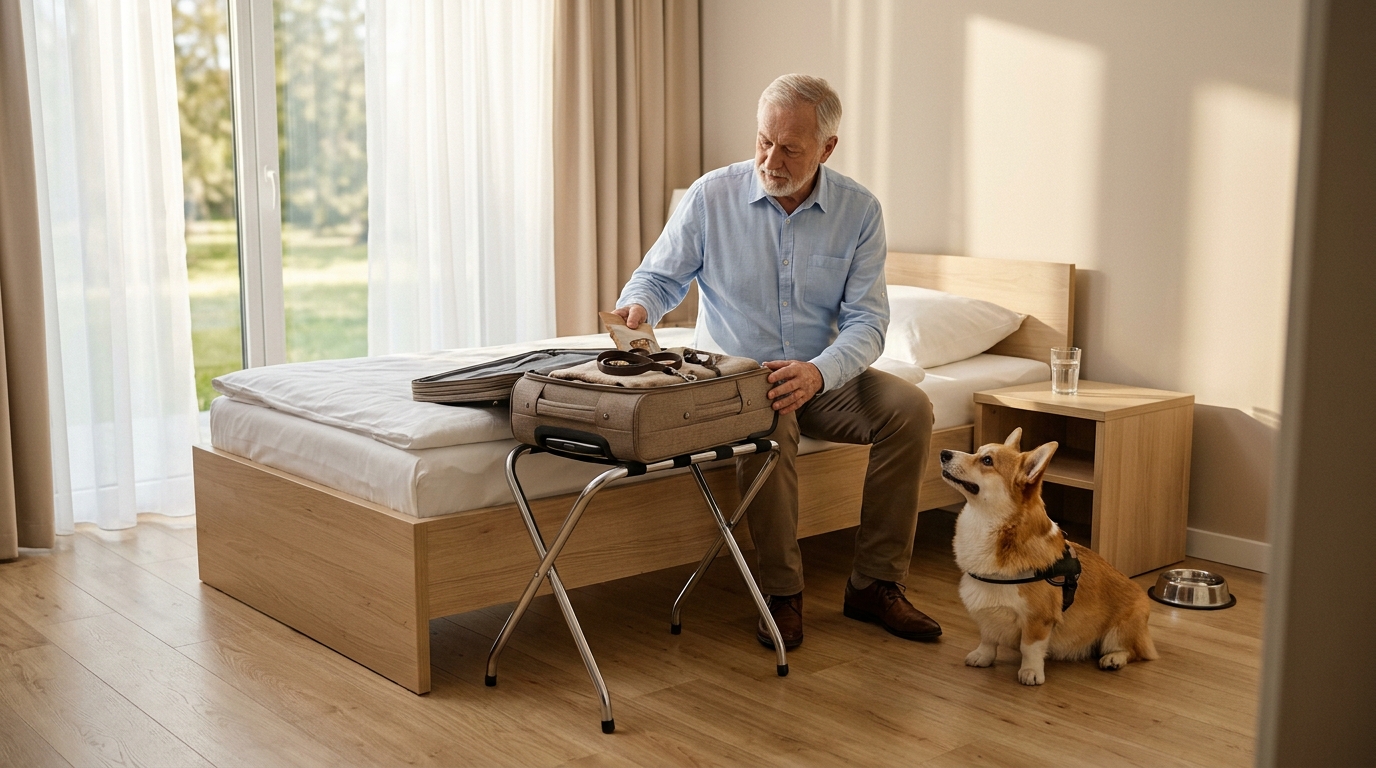
Plan your day, not just a single treatment
Check the approximate times of sessions and meals, and look through the whole schedule after you arrive. Allow for walking between places, waiting and rest, not just the time of the treatment itself. You can request particular times, but do not assume that all services can be rearranged at will. Fit your dog-care plan around the needs of your rehabilitation.
Also check the rules for room cleaning, including whether you or the animal must be present or absent. Have the contact details of someone who can help if you are delayed, feel unwell or your plans for the day change.
What to pack for your dog?
Documents and contacts: proof of vaccination, the documents required by the facility, confirmation of permission for the stay and your vet's phone number. Also note the contact details of a veterinary clinic nearby.
Food and everyday care: the food your dog usually eats, bowls, a supply of poo bags and any medicines your dog takes as recommended by the vet.
Rest and walks: its own bed or mat, a familiar blanket, a lead, a collar or harness with an ID tag and a separate towel for its paws. Prepare a muzzle or carrier if the facility or your chosen carrier requires one.
This is a list of things for your pet. Prepare the guest's own luggage using the guide “What to pack for a sanatorium? Complete list for 7, 14 and 21 days” so that you do not forget your own documents and medicines.
7. Frequently asked questions
Can I take my dog to an NFZ-funded sanatorium?
Do not assume so on the basis of the referral alone or of the facility's commercial offer. Check the rules of the sanatorium named in the confirmation for your stay. An assistance dog for a person with a disability has separate statutory rights.[1][2]
Where can I find a private sanatorium that accepts animals?
Start with facilities whose programme matches your needs. Then check the current terms of the chosen offer and confirm that your dog will be accepted on those dates. A list of spa towns does not replace checking the specific sanatorium and room.
How much does a dog's stay at a facility cost?
Check the current cost for the specific stay: the rate for the dog, the number of days charged and any supplements. Calculate the deposit separately. The example in section 3 shows how to calculate the cost, not a typical market price.
Can my dog stay alone during my treatments?
Only if the facility's rules allow it and you can provide suitable conditions for your dog. Confirm the requirements, how you will be contacted and a back-up plan. If it is not allowed or your dog has problems being alone, arrange care instead of assuming it is enough to close the door.
Which of my dog's documents should I take to the sanatorium?
Confirmation of a current rabies vaccination and the health record book or other documents required by the facility. Check the list in advance. Not every item from an online guide is a universal requirement.[3]
Can a small dog come with me into the dining room or to a treatment?
Neither a small size nor carrying the dog in your arms replaces permission to enter a given area. Check the rules for the dining room and the treatment facilities. Do not confuse them with the rights of a person who uses an assistance dog.[2]
8. Summary: rehabilitation and care without rushing
A successful sanatorium stay with your dog starts before booking: with confirmation that the animal will be accepted, the right room, the full cost and a plan for care during treatments. Then adapt daily walks and equipment to your own needs and those of your pet.
Do not choose a facility just because it accepts dogs. Look for a place where the conditions of the stay will let you take part in rehabilitation and rest, without leaving the care of your animal to chance.

Want to find the perfect place to recover without queues?
Health shouldn't wait in a queue. With the Vitalnia platform you can find availability at the best private sanatoriums and make a secure online booking in minutes. Whether you're booking a stay for yourself or someone you love — take control today.
See what we've prepared for you and your loved ones