Rehabilitation stays for wheelchair users: how to check a facility's real accessibility?
Author: Karolina Biernacka · Published: · Updated:
The photo shows a ramp, the description mentions a lift, and reception assures you that the room is adapted. But you still do not know whether you will fit in the bathroom, be able to reach the bed from the right side and get to all your treatments. These are exactly the details worth agreeing before booking, not after you arrive.
Compare rehabilitation stays for wheelchair users through the lens of your own everyday life: how you move around, the equipment you need and the help you require. If you are organising the trip for someone close to you, prepare this list together. Below you will find a way to check a facility, a checklist and a short template message about missing accessibility details.
1. How to check a facility before booking?
Start with the dimensions of the wheelchair you use: its overall width and its length with the footrests, not just the seat width. For a lift or platform, also take into account the weight of the wheelchair, the user and any accompanying person. Note which side you need space on next to the bed and the toilet, and whether you use a hoist, a shower chair or other equipment.
Then go through four stages. This is a suggested way of organising your check of the offer, not a formal building survey.
| Stage | What to establish? |
|---|---|
| Type of stay | Are you choosing a stay covered by PFRON rules, or another stay with rehabilitation? If you are receiving funding, check the relevant entries for the facility and the organiser. |
| Measurements and routes | Check the dimensions of doorways, the lift and the free space next to the bed and in the bathroom, as well as the whole route from arrival to the room, dining room and treatment rooms. |
| Photos and equipment | Check up-to-date photos of the right room and bathroom, ideally with measurements. If the layout is unclear, a floor plan or a short video will help. |
| Written arrangements | Confirm that the agreed accommodation and equipment will be available throughout the stay, as well as the scope of help, the costs and the rules for any change of room. |
A room number makes identification easier, but it does not have to be the only way of confirming the conditions. If the facility does not allocate room numbers in advance, you need a clear description of the room and written confirmation of the agreed details. A general phrase such as “subject to availability” does not settle where you will be accommodated.
2. List of facilities: the OD and OR registers in Empatia
For a residential rehabilitation stay funded by PFRON, the Polish State Fund for Rehabilitation of Disabled Persons, check both the facility and the organiser. They are not always the same entity. PFRON states that both must have authorisations appropriate to the type of stay and to the participant's dysfunctions or conditions.[1][2] Do not confuse this procedure with every private sanatorium package that is called a “stay” in an advert.
In the official Empatia portal you will find a register of facilities (OD) and a separate register of organisers (OR). Check the name, address, scope of authorisations and the expiry date of the entry, which must cover the planned stay.[3][4]
Pay attention to the full description of dysfunctions: general information about the musculoskeletal system is not enough. An entry may exclude wheelchair users. If you are receiving funding, you need a scope that matches your situation, and if anything is unclear, check the information from the organiser and from the relevant district family support centre (powiatowe centrum pomocy rodzinie, PCPR).[1][2]
The register is not a booking calendar. The search tool includes, among other things, the number of beds for wheelchair users. Do not treat it as the number of free rooms on your dates. First check the availability of the right room in the Vitalnia offer, then confirm any missing information about its layout and equipment directly with the facility.[3]
3. Doors, thresholds, lifts and ramps
Trace the whole route: where you get out of the car, the entrance, reception, the room, the bathroom, the dining room and the treatment rooms. A single narrow passage or step can cancel out the convenience of everything else. The questions below are for checking how the facility can be used, not for judging for yourself whether it complies with the law.
Doors and thresholds: check the actual clear width
Check how many centimetres of clear passage remain once the door is open, not the nominal size of the door leaf. The space to approach and turn in front of the door, the direction in which it opens and whether you can operate the handle also matter. With double doors, find out whether the leaf you need will be available without having to ask staff each time.
Section 15 of the Polish regulation on rehabilitation stays, among the conditions for registering a facility for the relevant groups of participants, specifies, among other things, doors with a clear width of at least 90 cm, with no threshold or a threshold no higher than 2 cm.[1] This is a specific scope of the regulations, not a guarantee that every wheelchair can pass through comfortably. Check the exact height of each threshold. Descriptions such as “low” and “almost threshold-free” are not enough.
Lift or platform: check more than whether there is one
You need the door width, the internal dimensions of the car or platform, the load capacity and a photo of the space in front of the entrance. Compare these with your own wheelchair and the way you get in and out. Do not assume that a carer will fit in too just because the device has an accessibility symbol.
Find out whether the device serves all the levels you need, whether it requires a key or a member of staff and at what times it operates. Check what happens in the event of a breakdown and how help will be given in an emergency. A lift being generally accessible is not an evacuation plan.
Ramp and access: the whole route counts
Check the length and gradient of the ramp, its width, the handrails and the space to stop in front of the door. Find out what the surface is and whether the entrance is always open. Do not judge from a photo alone that you will definitely manage the ramp on your own.
Also check the space for getting out of the car or unfolding a vehicle ramp. If you need to go outside between buildings, the distance, kerbs, slopes, lighting and maintenance of the route in rain or snow matter. A connecting corridor is a convenient solution, but the mere fact that there are several buildings does not in itself decide whether the offer is suitable.
4. The room and bathroom: accessibility in everyday use
It is worth assessing barrier-free rehabilitation facilities at the level of the right room, not just the whole building. A photo of one adapted bathroom does not confirm the equipment in all the rooms available for sale.
The bed and space to manoeuvre
Check the height of the top of the mattress and the width of the free space next to the bed on the side you need. Find out whether furniture can be moved and whether a height-adjustable bed can be provided if you need one. If you use a mobile hoist, also confirm the space under the bed and the room needed to use it. The mere presence of such a device in a storeroom does not settle these questions.
Check access to the wardrobe, telephone, switches and a socket for charging an electric wheelchair. Find out whether the equipment you need can be reserved for the whole stay, what the price includes and whether there is a weight limit.
The bathroom: not just grab rails
A universal design guide prepared for the city of Gdańsk specifies, among other things, a manoeuvring space of 150 × 150 cm and space for transferring next to the toilet.[5] Treat this dimension as a reference point, not as confirmation that the bathroom suits every wheelchair. What counts is the free floor space once the fittings are in place, and the manoeuvring needs of different wheelchairs can vary.[5]
Toilet. Check the seat height, the free space on both sides and the layout of the grab rails. Say which side you need to approach from to move across, that is, to transfer. Free space on the side opposite to the one you use may not solve the problem.
Shower. Confirm that there is no step or shower tray edge, the width of the entrance, space for the chair you use, and the type of seat and grab rails. Check the permitted load and whether the equipment available meets your needs. The term “walk-in” does not replace a description and measurements.
Washbasin and fittings. Check the knee and footrest clearance and whether you can reach the tap, mirror, towels and flush.
Calling for help. Find out whether there is a working call button or pull cord in the bathroom, whether it can also be used from floor level and who responds to the call. Design guidelines take this kind of accessibility of fittings into account.[5]
5. Treatments, the dining room and staying with a carer
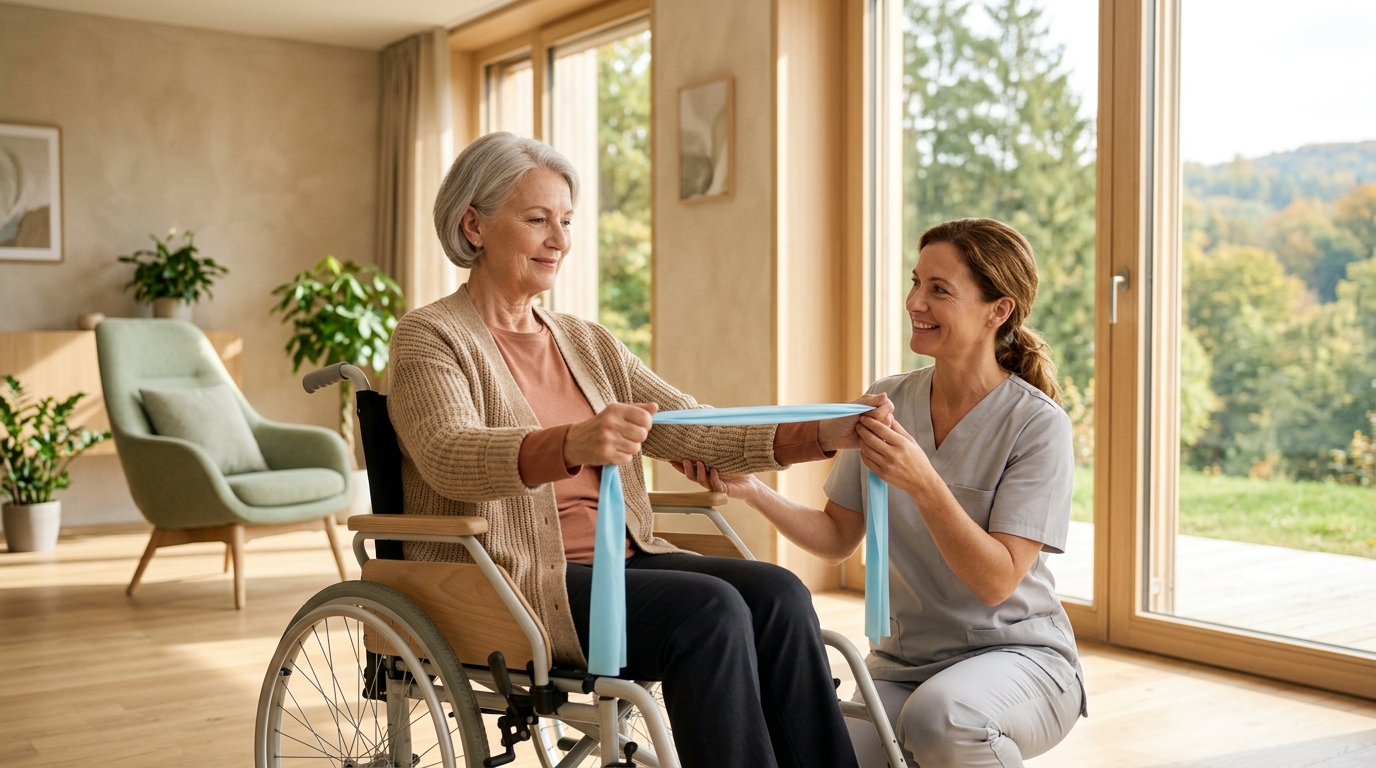
Check how you can use treatments, not just how to get to the treatment room
Find out how transfers from the wheelchair to the treatment table take place and who helps when needed. Check the availability of adjustable tables, hoists and the right accessories. Confirm the rules for reserving equipment and the presence of staff during your sessions, not just the facility's general list of equipment.
At the pool, also check the changing room, the shower and how you get into the water. A pool hoist does not necessarily mean you can use it at any time or without help. Agree the scope of rehabilitation and the safe use of equipment with the medical staff. This guide does not replace an eligibility assessment or instruction.
The dining room and help with everyday activities
Find out whether you can get up to the table in the wheelchair you use, move between tables and use the buffet. If you need help carrying your meal, check who will provide it. Check the diet you need and any supplement in the terms of the offer.
Discuss help with washing, dressing, using the toilet or changing position separately. Do not assume that a package with treatments includes these activities or round-the-clock care. Check the scope of services, the hours, the cost and how to call for help.
Do you need to travel with a carer?
Do not draw this conclusion simply from the fact that you use a wheelchair. First establish which activities you do on your own and which ones you need support with in the conditions of the chosen facility. If you are travelling with someone close to you, agree a shared room, meals and whether they can accompany you during sessions. Do not assume that their stay is included in the price of your package.
When a person with a severe or moderate degree of disability applies for PFRON funding for a carer's stay, the doctor justifies the need for the carer's help in the application. The carer must meet separate conditions and must not need care from another person themselves. This does not mean that everyone with a particular degree of disability is barred from acting as a carer.[1][2] Check the funding conditions with the PCPR — they are not the same as arranging day-to-day help during the stay.
6. How to compare the facilities you have chosen?
Once you have chosen a few offers on Vitalnia, separate the essential conditions from the extras. If you need a specific bathroom layout or help with transfers, a larger pool or a longer list of treatments will not make up for it.
Accommodation and support first. Compare the same scope: a room with agreed specifications, accessible routes, equipment and help. Mark unconfirmed information as “to be clarified” instead of counting it in the offer's favour.
Then the programme and organisation. Check who assesses eligibility for rehabilitation, what experience the staff have in working with similar needs and whether the programme includes the individual sessions you need. Check whether the plan can be adapted, how services that were not provided are settled and what recommendations you receive at the end of the stay. We describe how to compare packages in the guide “Private sanatorium stays with treatments: how to compare packages and choose wisely?”.
Finally, the full price. Take into account the stay of an accompanying person, equipment hire, help and any other supplements you need. Do not judge accessibility by price, the number of stars or the age of the building. Check the terms of the chosen offer on Vitalnia, and confirm with the facility that the agreed accessibility details that were missing will be provided throughout the stay, and what will happen if the facility cannot keep to them.
7. Checklist before booking
First choose the dates and type of stay on Vitalnia. Use the list below to check the description of the offer, then confirm with the facility only the missing accessibility details for this stay.
| Area | What to check or confirm? |
|---|---|
| Room | Which room or precisely described type of accommodation will you get? Will the agreed equipment be available throughout the stay? |
| Doors and route | How many centimetres of clear passage do the doors to the room, bathroom and treatment rooms have? Where are there thresholds, steps, slopes or doors that require help? |
| Lift | What are the car dimensions, entrance width and load capacity? Does it serve the levels you need, does it require staff and what is planned in case of a breakdown? |
| Bed and bathroom | What is the height of the mattress and the toilet seat? How much space is there next to the bed and on the side of the toilet you need? Is the shower step-free? |
| Equipment | Can the bed, shower chair or hoist you need be reserved? What model is it, and what are its weight limit, accessories and cost? |
| Treatments and meals | Will you be able to reach all the rooms you need? How is help organised for transfers, getting into the pool and meals? |
| Care | What help does the facility provide during the day and at night? Who responds to a call from the room or bathroom? What are the conditions for an accompanying person's stay? |
| Confirmation | Will you receive up-to-date photos and measurements? What does the facility do if the room changes or the agreed equipment is not available? |
Message about missing accessibility details
Hello, I am considering a stay on [dates], in the [package name] option. I use a [type] wheelchair, measuring [overall width × length with footrests]. I need [space to transfer on a particular side / equipment / type of help]. I could not find information in the offer description about [missing details]. Please confirm these for a room available for the whole stay, and describe what will happen if the agreed room or equipment is not available.
In your first message, give only the functional information needed to confirm accessibility. Do not send medical records or any data unrelated to this purpose. Agree separately with the person responsible for the eligibility assessment how to send records securely. Preparing your luggage is described in the guide “What to pack for a sanatorium? Complete list for 7, 14 and 21 days”.
8. Frequently asked questions
Does an entry in the OD register mean that every room is adapted?
Do not treat an entry as confirmation of the specifications of every room. Check the scope of authorisations, then the right accommodation, the route to sessions and the equipment. In Empatia, data on places for wheelchair users is separate from the total number of beds.[3]
Where can I find a list of facilities offering rehabilitation stays for wheelchair users?
For a funded stay, start with the official Empatia registers of facilities and organisers. Check that the entry is valid and has the appropriate scope. The list will help you shortlist places to check, but it does not replace establishing the conditions of a specific room.[2][3][4]
Does the number of places in Empatia mean there are free PFRON places on my chosen dates?
No. Data on accommodation capacity does not confirm a booking or a free room for the whole stay. Check the availability of the right room in the chosen offer, and if detailed accessibility specifications are missing, confirm them with the organiser or the facility.[3]
Which bathroom dimensions do I need to check?
Check the width of the entrance, the free manoeuvring space, the space on the right side of the toilet and the dimensions of the shower area. Also find out the heights and fittings. The bathroom's floor area or a declared 150 × 150 cm space on its own does not confirm that every wheelchair and hoist can be used.
Does a wheelchair user or a person with a severe degree of disability have to travel with a carer?
Establish your needs individually: take into account your everyday independence, your state of health and the help available at the facility. Do not equate using a wheelchair with having to travel with a carer. When applying for funding for the carer's stay, the doctor justifies the need for help in the application.[1][2]
Is a room number in the confirmation enough?
No. The number identifies the accommodation but does not describe how suitable it is. Also confirm the layout, measurements, equipment and availability for the whole stay. If the room number is not set in advance, agree clear specifications and the rules for any change of room.
9. Summary: choose conditions you know
A well-planned rehabilitation stay starts with your needs, not with a wheelchair symbol in a brochure. Check the right room, whether you can use the bathroom, the route to treatments and meals, and the help agreed. If you are receiving funding, add a check of the relevant register entries.
Measurements, photos and written arrangements help reduce the risk of misunderstandings, but they do not guarantee a problem-free stay. The most useful offer is one where you know what you will do on your own, what support you will receive and what you are paying for.
Start by comparing facilities on Vitalnia
In the Vitalnia catalogue, look through facility profiles and information about their facilities. Check the dates, price and terms of the offer, and if critical accessibility details are missing, confirm with the chosen facility the conditions of the room, routes and equipment, and the help you need.
Find a facility on Vitalnia.pl