Sanatorium with a swimming pool: what to check before choosing a stay
Author: Karolina Biernacka · Published: · Updated:
When choosing a sanatorium with a swimming pool, think about how you will use it. First check how you will get into the water, who will run the sessions and what the chosen package includes. Photos of the wellness area will not show you the exercise times, additional charges or whether you will get the help you need.
If you are organising a trip for your mum or dad, talk about their everyday needs. Can your loved one manage stairs, get changed and move around on a wet floor on their own? Do they want to swim at a gentle pace, or are they looking for exercises suited to a health problem? The answers will help you compare offers and clarify the details before you choose a stay.
1. Recreational pool vs rehabilitation sessions
In a stay description, you may find “swimming pool”, “wellness area” or “exercises in water”. Each of these needs clarifying. For rehabilitation, what matters is an exercise programme adapted to the guest's abilities and the way the sessions are run.[1][2]
| Wording in the offer | What to find out | What to check before choosing |
|---|---|---|
| Pool access | The rules for using the pool on your own. | Are visits limited in time or number? |
| Rehabilitation exercises in water | The programme, the instructor and the form of the sessions. | Who runs the exercises, how long do they last and how many people are in the group? |
| Therapeutic baths | The type of treatment and where it takes place. | Is it a bath in the pool or in a bathtub, and how does the eligibility assessment work? |
Also find out whether exercises and recreational swimming take place in the same part of the pool, and whether other guests use it during therapy. The mere presence of a swimming pool at a facility does not determine which services your package includes.
We explain the names of methods you may come across in offers in the guide Physiotherapy vs physical agent therapy.
2. Seven criteria for choosing a sanatorium with a swimming pool
Start with the description of the chosen facility and the specific stay on Vitalnia. Check the practical information in the package description and the terms of the offer, and ask the medical staff whether the sessions suit your health.
1. The way from the room to the pool
Check which building and which floor the pool is on. Trace the whole route from your room through the changing room to the water. Stairs, thresholds, a lift that serves the floors you need and a place to rest all matter.[3]
If the pool is in a separate building, find out the distance and whether a covered walkway leads to it. Allow time to dry off, get changed and walk back. With limited mobility, even a short route with a few steps can be harder than a longer, level corridor.
Can I get from the proposed room to the pool without stairs or going outside?
2. Getting into the water and help with transfers
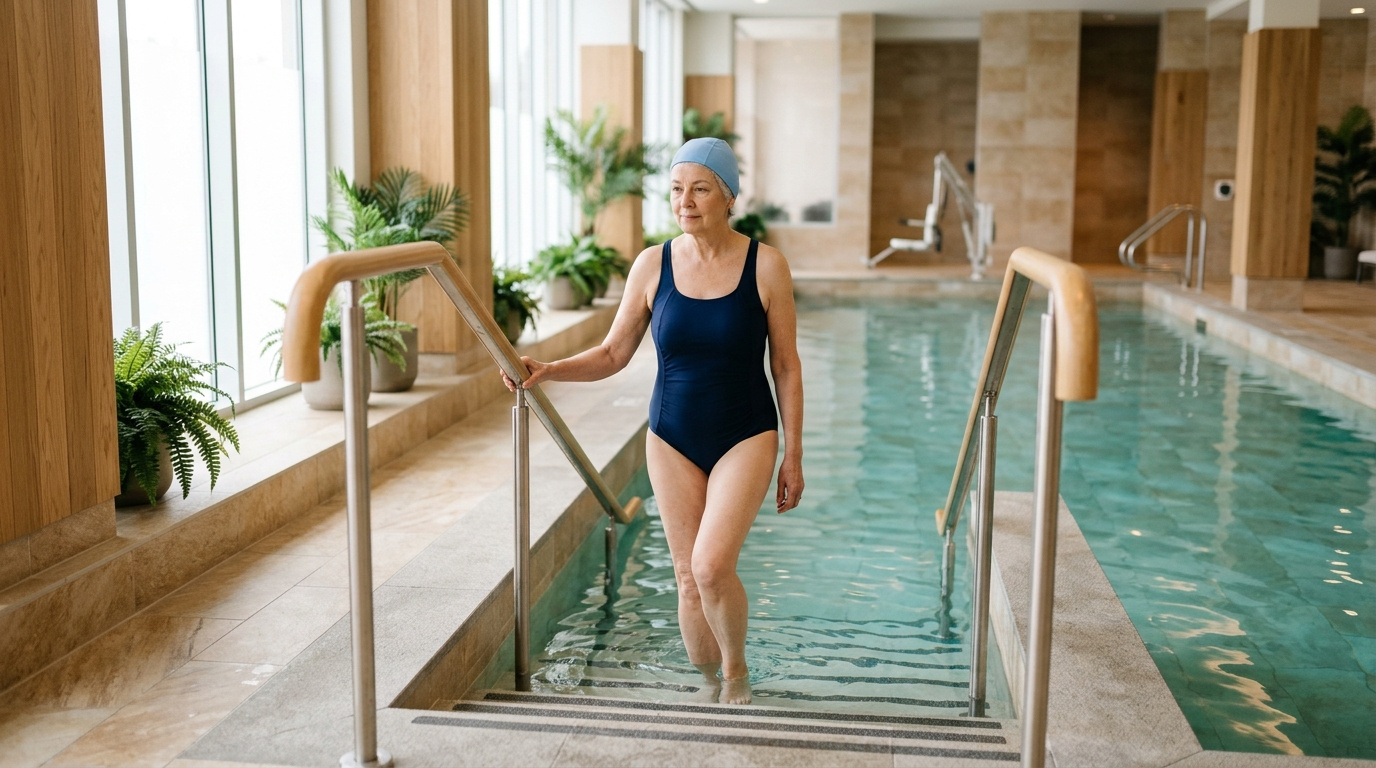
If a vertical ladder is difficult for you, check the facility description on Vitalnia for steps with handrails, a ramp or a pool hoist. Being able to get out comfortably after the session also matters. Steps, handrails and hoists are solutions used in accessible therapy pools.[9]
If you use a wheelchair, clarify how the transfer works, the type of seat and the maximum load of the hoist. Check that the equipment will be available during your stay and what happens if it breaks down. Separately, agree on help from the staff, whether assistance must be booked in advance and any additional charges. Do not assume that the presence of equipment means all the help you need will be provided.
How will I get into and out of the water, and who will help me with transfers?
We describe the details of the room, the lift and other routes in the guide Rehabilitation stays for wheelchair users.
3. Water depth and temperature
Check the depth where the exercises take place and whether the floor slopes deeper. It is also worth knowing whether handrails are available and how you will be supported during the session. Discuss these details with the instructor, taking into account your height, balance and the way you move.
Check the actual water temperature in the specific pool. Phrases such as “warm pool” or “thermal water” are too vague to assess an offer. The medical staff should take the bathing conditions and the physical effort into account when assessing eligibility for therapy.[1][2]
What are the water depth and temperature where my sessions take place?
4. Running the exercises and pool supervision
If the offer lists treatments in a rehabilitation pool, check who runs the sessions, how the exercises are chosen and whether the work is individual or in a group. Check the group size and whether help is available if you have difficulties. You can check a physiotherapist's right to practise and their current status in the National Register of Physiotherapists (Krajowy Rejestr Fizjoterapeutów).[4]
Separately, check lifeguard supervision during sessions and recreational swimming. Water rescue covers responding to hazards, giving first aid and evacuation.[5] The presence of a lifeguard does not mean that pool access includes physiotherapy or constant one-to-one assistance.
Who runs the therapy, and who is responsible for lifeguard supervision during my pool time?
5. Changing rooms, showers and hygiene
Check whether the changing room has a stable seat and whether the shower has grab rails, a place to sit and an entrance without a high threshold. Check for non-slip flooring, marked steps and space to move around with a walking frame or in a wheelchair.[3] If you need a carer's help to get changed, find out whether you can use a suitable room together.
Also check where the current notice on water quality is displayed. The Polish Sanitary Inspection (Inspekcja Sanitarna) states that this information is made available at the facility or on the swimming pool's website.[6]
Can I use the changing room and shower comfortably, and where can I check the water quality information?
6. Pool hours and maintenance closures
If you are choosing a sanatorium with an indoor pool, check whether you will be able to use it throughout your stay. Check the exercise times, recreational access and the rules at weekends and on public holidays. Check whether you need to sign up in advance, whether there are limits on numbers and whether the pool is open to outside visitors.
Find out whether any renovation, inspection or other maintenance closure is planned during your stay. If the pool is the main reason for choosing an offer, it is worth knowing what happens if it is unavailable. Also check whether the timetable fits in with meals, other treatments and rest.
Will the pool be available throughout my stay, and at what times can I use it?
7. Price and scope of the package
Check whether the price covers pool access only, exercises with a physiotherapist, an eligibility consultation or a set number of baths. For sessions, you need to know how many there are and how long they last. The length of the stay does not tell you how many times you will use the pool.
Check the Vitalnia offer for charges for extra pool visits, help with transfers, pool access for a carer and towel or bathrobe hire. If the medical staff rule out a planned treatment, rules for replacement and settlement agreed in advance will help avoid misunderstandings. Keep the description of the offer and the main booking terms.
What exactly does the price include, and how is a treatment I cannot have for health reasons settled?
You can compare the other elements of an offer with the help of the guide Private sanatorium stays with treatments.
3. Type of water in the pool
The buoyancy of water helps take the load off the body, and its resistance can be used during exercises. This also happens in ordinary pool water. Warm water can make it easier for muscles to relax and to move. However, the choice of exercises depends on the guest's needs and abilities.[2]
If you are choosing a sanatorium with a brine pool, check where the water comes from, its composition and its concentration. The term “brine” describes the salinity of the water. “Thermal”, on the other hand, relates to the temperature of the natural water as it flows out of the source.[7] It follows that the name alone does not tell you the temperature maintained in the pool.
Do not judge whether treatments suit you only by the name of the water. Find out which sessions take place in a given pool and whether they are right for you. Being able to follow the recommended programme matters more when choosing a stay than a slogan such as “wellness complex”.
4. Eligibility for exercises and baths
Before buying a package, find out who carries out the eligibility assessment and when the consultation takes place. In commercial physiotherapy, a doctor's referral is not always required, but an assessment of health and physical fitness is needed. If in doubt, the physiotherapist refers you for a further consultation.[1]
If you have a chronic condition or have had surgery, discuss the planned trip and sessions with your treating doctor. Check in the offer description which medical records to bring. Also tell the staff about any recent change in medication, new wounds, a skin infection or if you feel worse.[8][9]
Fever, diarrhoea and vomiting are reasons to postpone going into the pool and to contact the staff. Decompensated heart failure, breathlessness at rest and an unstable condition after a serious health event are contraindications to hydrotherapy. In such a situation, do not start the sessions and contact a doctor.[8]
If chest pain, dizziness or marked weakness occurs during a session, stop exercising and tell the staff straight away.[9]
5. Frequently asked questions
Do you need to be able to swim for rehabilitation in water?
Not always. Some sessions take place in conditions that allow non-swimmers to exercise. Check that the depth, the way into the water and the support available are suitable. Tell the physiotherapist if you cannot swim or are afraid of water.[9]
Is a brine pool suitable for every older person?
There is no such rule. Whether the sessions are suitable depends on an individual assessment, the bathing conditions and the therapy plan. Do not choose a treatment just because the offer calls the water therapeutic. Ask the medical staff about indications and contraindications in your situation.[1][8]
Can I use the pool if I have high blood pressure or heart disease?
This needs to be decided individually with a doctor. The name of the condition alone is not enough to decide. What matters is your current health and how stable your treatment is. In decompensated heart failure or breathlessness at rest, hydrotherapy is contraindicated.[8]
Does a private stay mean unlimited pool access?
Paying for a stay does not in itself mean this. Check the number of visits, the length of a single visit, the opening hours and the rules for signing up. Recreational pool access, exercises with a physiotherapist and use of the rest of the wellness area may be separate items in the offer.
Can I have pool treatments during a stay funded by the Polish National Health Fund (NFZ)?
They can be part of the programme if the facility provides them and they are suitable for the guest. In NFZ-funded spa treatment at a sanatorium, the programme is set after a medical examination and adjusted during the stay. Having a pool does not automatically mean daily sessions in the water. Check the rules for recreational pool access separately.[10]
Do I need a medical certificate for exercises in water?
It depends on the type of service and the facility's rules. Before you travel, check the offer description for requirements concerning a referral, a certificate or an examination on site. Commercial physiotherapy does not always require a referral, but it does include an assessment before therapy.[1]
6. How to compare offers on Vitalnia
On Vitalnia, you can look through treatment profiles, descriptions of treatments and amenities, and photos of facilities. For selected facilities, stays, dates, prices and rooms are also available. When looking for a sanatorium with a swimming pool by the sea or in the mountains, compare the conditions for using the pool in specific offers.
Choose a few options and check them against the criteria described above. When choosing a stay for an older person, pay particular attention to the way from the room, getting into the water and the help available. Also check which services the package you are interested in includes.
Once you have chosen an offer, check the availability of the dates, the scope of the package and the terms of the stay on Vitalnia, and discuss the choice of therapy with the medical staff. This way you will prepare a stay that meets your or your loved one's everyday needs.
Compare facilities and stay offers on Vitalnia
Check the scope of the package, the conditions for using the pool, dates and prices. Compare pool access and sessions with a physiotherapist separately, and discuss the choice of therapy with the medical staff.
See offers on Vitalnia